How a Professional Photo Affects Your Personal Brand
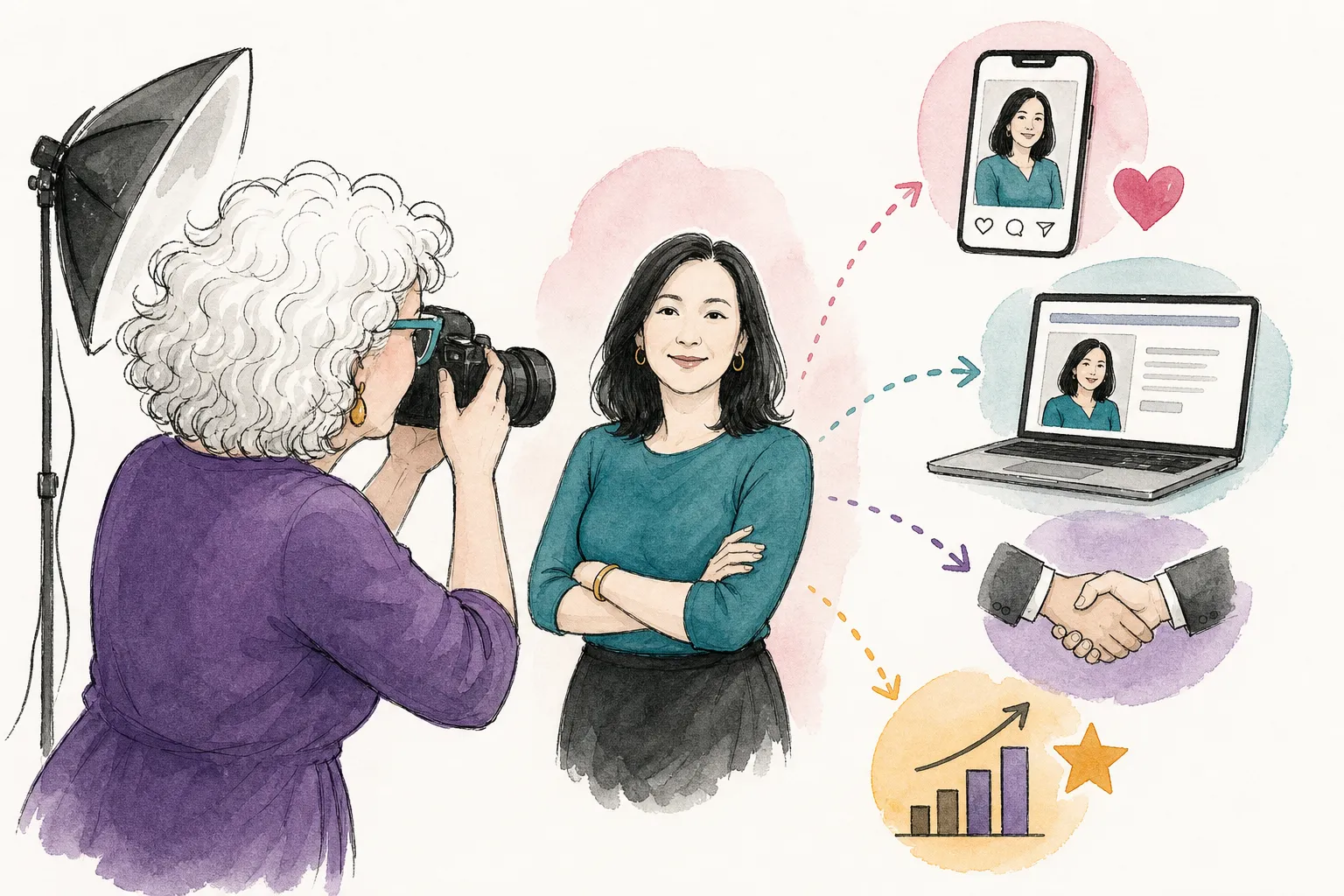
Table of Contents
- What people decide in the first fraction of a second
- The numbers people cite
- What a weak photo actually costs
- Headshot or branding session
- Why direction matters more than the camera
- Briefing your photographer, and what to do afterward
- Before the shoot
- Wardrobe
- Usage rights
- After the session
- Where that leaves you
Someone opens your LinkedIn profile and forms an opinion about you before they read a single word of your summary. You spent hours on that summary. You paid someone to write your website copy. Then the photo at the top of the page is a cropped group shot from a wedding, or a conference snapshot where the overhead lights put shadows under your eyes.
The photo is doing work whether you chose it carefully or not. This piece covers what your current photo is telling people, which kind of session actually fits where your brand is right now, and what to do with the images once you have them.
What people decide in the first fraction of a second
Princeton researchers Willis and Todorov found that people form judgments about trustworthiness, competence, and likability from a face in roughly 100 milliseconds. Their study showed those snap judgments lined up closely with what people concluded after unlimited viewing time. Extra seconds mostly made viewers more confident in the call they'd already made.
I think about that number constantly when I'm shooting. The verdict lands before anyone reads your credentials or your client list.
What registers in that moment is fairly mechanical: whether your face is clearly visible, how you're framed, what your expression is doing, whether the light is helping or getting in the way. An amateur photo reads as more than low production value. It suggests the person didn't think the moment was worth preparing for, and viewers transfer that impression straight onto how they imagine the work.
The numbers people cite
LinkedIn's platform data says profiles with professional photos get 21 times more views, 36 times more messages, and 9 times more connection requests than profiles without a photo. Those figures come from LinkedIn itself rather than an independent study, so treat them as directional. A 2024 Ringover survey of 1,087 U.S. recruiters found 74.4% were more inclined to interview candidates whose profiles included a professional headshot. Recruiters screen a profile in about six or seven seconds, and the photo takes up a real chunk of that window.
On the website side, businesses that swap stock or amateur images for custom photography regularly report conversion improvements, with figures in the 40% range showing up in case analyses across e-commerce and professional services. Results vary enormously by industry. Still, the photo on your about page is functioning as a conversion element, not decoration. Visitors decide whether to book a call partly on what your face is telling them before they've read your copy.
Consistency compounds all of this. When the same visual identity shows up on LinkedIn, your website, your media kit, and your Instagram, recognition builds with each exposure. Scattered images from different years and different lighting work against you quietly.
What a weak photo actually costs
No photo at all rarely reads as neutral. Recruiters and prospective clients tend to fill that blank with something, usually unfamiliarity with professional norms or a sense that something's being hidden.
Research on headshot perception shows that photos read as casual or low-effort score lower on perceived competence and interview intention, even when the person's qualifications are identical to someone with a professional headshot.
Here's the part most people miss. You judge your own photo by whether it looks like you, and you're a terrible judge because you have decades of familiarity with your own face. A stranger has none of that. They're reading your posture, your eyes, and your energy. You're checking whether your hair looks the way it usually does.
A directed session closes that gap. The goal is an image that works on someone who has never met you.
Headshot or branding session
A headshot is a clean, straightforward portrait built for professional identification. It belongs on your LinkedIn profile, in the company directory, on your speaker bio and your email signature, anywhere one strong face-forward image has to carry you. Executives replacing a photo from 2019, professionals coming back into the workforce, and anyone whose brand mostly lives on LinkedIn should start here.
A personal branding session does something different. Entrepreneurs, speakers, authors, and consultants need a library, not one image. Portrait photography for entrepreneurs at that level means multiple outfits, several setups, and a range of expressions that can carry an about page, fill a media kit, feed a social calendar for months, and support a press feature.
If everything is pointing at one professional profile, book the headshot. If the images have to run a website, a pitch deck, a feed, and a press kit at the same time, the branding session is the more practical spend. Either way the foundation is identical: someone directing you who knows what each frame has to accomplish.
Why direction matters more than the camera
Most people who describe themselves as bad in front of a camera are simply undirected. Left alone with no guidance on where to put their shoulders, where to look, or what to do with their mouth, people tense up. You end up with a technically sharp photo of someone bracing for impact. Stiffness kills the warmth and trustworthiness that make a photo work.
I don't like being photographed myself. That shaped how I run a session more than any workshop I've taken. Nobody gets told to relax and be natural, which has never worked on anyone. I coach every pose and every expression in real time, and I've been doing it with clients since 2016. Most of my clients arrive convinced they're not photogenic and leave with images they'll actually use.
Real confidence looks different from performed confidence, and the camera catches the difference. Relaxed shoulders, eyes that are actually engaged, an expression that matches the person's own energy. A smile held thirty seconds past its natural life reads exactly like what it is.
You review your images with me the same day, so you leave knowing you have what you came for. Every session is backed by a satisfaction guarantee.
Briefing your photographer, and what to do afterward
How specific you are up front determines how closely the images match what you needed.
Before the shoot
Name the destinations for every image. LinkedIn, website, media kit, speaker bio, pitch deck. Then build a small mood board with references and a note on each one explaining what you actually like about it, whether that's the light, the crop, the expression, or the colors. "I like this" tells your photographer nothing. "I like how open the expression is here" tells her everything. Finish with a prioritized shot list and the ratio of vertical to horizontal frames your platforms need.
Wardrobe
Wardrobe matters more than most clients expect. Bring the colors and silhouettes that fit your brand, and say out loud what you want to avoid, especially colors that fight your brand palette and small patterns that go strange on screen.
Usage rights
Sort out usage before the shoot rather than after. Commercial placements, paid advertising, and any exclusivity window all change the licensing terms you need.
After the session
Change everything at once instead of updating your LinkedIn photo and calling it done. Profile photo and banner, website about page and contact section, speaker bio PDF, email signature, media kit, and every active social profile. Recognition builds when the same face shows up in the same register everywhere someone might find you.
Where that leaves you
The evidence points one direction. A photo forms an impression in under a second, drives measurable visibility on the platforms where people look for you, and tells viewers something about the standard you hold yourself to. Most of the figures floating around are platform-reported or case-based rather than controlled experiments, so track your own before-and-after numbers if you want proof that applies to you.
Two decisions carry most of the weight. Pick the session type that matches where your brand actually is, and work with someone who directs you instead of operating a camera at you.
I photograph headshots and personal branding sessions in Chicago, and I work with a lot of people who dread the whole idea. If your current photo is a few years and a few haircuts behind, book a session or send me a note and I'll walk you through how it works.