Entrepreneur Brand Photo Guide
Table of Contents
- Start With the Opportunity You Want to Create
- Build a Photo List Around Real Uses
- Choose Settings That Support Your Message
- Let Your Wardrobe Do Its Job
- Plan for Expression, Not Perfect Posing
- A Four-Step Plan for Your Brand Session
- 1. Define your audience and priority platforms
- 2. Gather inspiration without copying it
- 3. Prepare your outfits and details ahead of time
- 4. Leave room for expert guidance
- Keep Your Final Images Working After the Session
Your next client may meet your face before they hear your pitch. They may find you on LinkedIn, scan your website’s About page, see a workshop announcement, or land on a social post while deciding whether to reach out. This entrepreneur brand photo guide is about making that first visual introduction feel clear, credible, and unmistakably like you.
Brand photos are not about pretending to be more polished than you are. They are about showing the capable, approachable professional your clients will actually work with. And if being photographed makes you nervous, you are very much not alone. You do not need to know how to pose, have a naturally serious “business face,” or show up with a perfect plan. You do need images with a purpose.
Start With the Opportunity You Want to Create
Before choosing outfits or saving photo inspiration, consider what you want your images to help you do. A consultant building referral relationships needs a different set of photos than a founder launching a product, a creative updating a portfolio, or an executive stepping into a more visible leadership role.
Ask yourself where people are most likely to encounter you and what you want them to feel in that moment. Perhaps you want potential clients to see that you are prepared and easy to talk to. Maybe you want hiring managers to recognize your leadership presence. Or you may want a growing audience to understand that there is a real, thoughtful person behind your business.
This clarity keeps a photo session from becoming a collection of nice-looking pictures with no job to do. Your images should support the way you work, the people you serve, and the next step you want them to take.
Build a Photo List Around Real Uses
A single headshot can do a lot, but entrepreneurs often need more than one kind of image. Think through the places your face and brand appear now, along with the platforms you plan to use over the next six to twelve months.
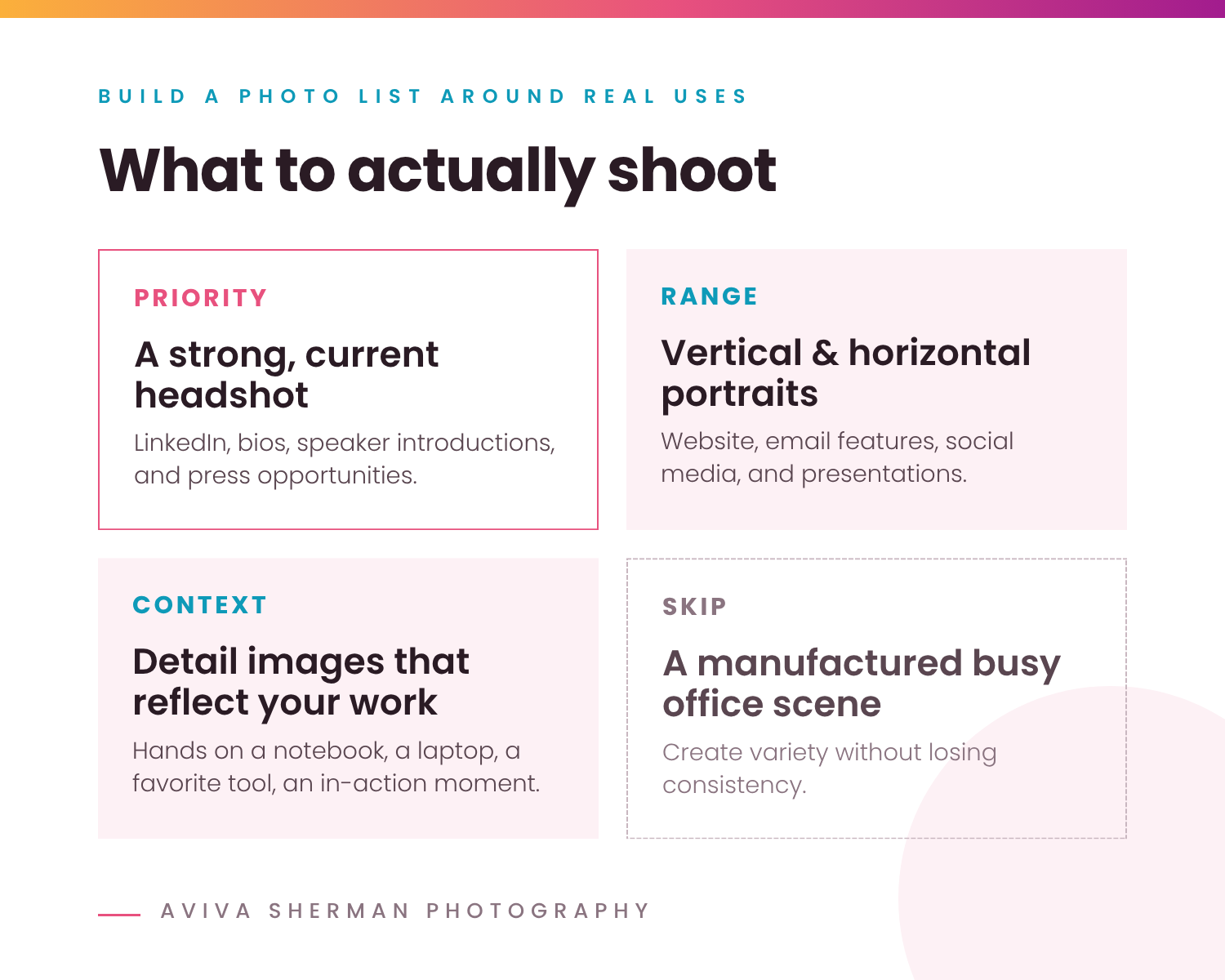
For most personal brands, the priority is a strong, current headshot for LinkedIn, bios, speaker introductions, and press opportunities. From there, consider a few vertical and horizontal portraits for your website, email features, social media, and presentations. Detail images can also be useful if they genuinely reflect your work: hands on a notebook, a laptop during a strategy session, a favorite tool, or a simple in-action moment.
The goal is not to manufacture a busy office scene if your business is primarily built through one-on-one conversations. It is to create variety without losing consistency. A clear, welcoming headshot may be the most valuable image in the entire set, especially if you are in a relationship-driven business.
Choose Settings That Support Your Message
A clean studio portrait puts the focus on you. It is often the right choice when you need an elevated, versatile image that can work across many platforms and be cropped easily for different formats. It also keeps your final photos from being tied to a trend, a temporary office, or a background that competes with your expression.
Environmental photos can add context when the setting says something meaningful about your work. A designer in a bright workspace, a chef in a kitchen, or a Chicago consultant meeting clients in a recognizable professional setting may benefit from that extra sense of place. The trade-off is that locations can become visually dated or distracting more quickly. When in doubt, start with timeless portraits and add environmental images selectively.
Let Your Wardrobe Do Its Job
The right outfit does not need to feel overly formal. It needs to help your audience read you accurately and keep your attention on the camera rather than on a neckline that shifts or a jacket that feels too tight.
Choose clothing that fits well, photographs cleanly, and feels aligned with the level of polish your clients expect. Solid colors and subtle textures tend to keep the focus on your face. Rich neutrals, jewel tones, and colors that complement your skin tone are often excellent choices. Very small patterns, prominent logos, shiny fabrics, and clothing with fussy details can pull attention away from you.
Bring options if your session allows for outfit changes. One look might feel more formal and leadership-focused, while another is slightly more relaxed for social media or a personal website. Variety is helpful, but consistency matters more. Your photos should all look like the same person leading the same business.
Grooming deserves a little advance thought, too. Schedule haircuts or color appointments early enough to feel settled into the result. Keep makeup and skincare close to your usual style, with a touch more definition if that helps you feel camera-ready. You want to look refreshed, not unrecognizable.
Plan for Expression, Not Perfect Posing
Many people arrive convinced they are not photogenic. Usually, what they mean is that they have been photographed without enough direction. A natural-looking image is rarely accidental. It comes from good lighting, a relaxed pace, thoughtful posture adjustments, and coaching that helps you find expressions that feel like your own.
You do not need to memorize poses from the internet. In fact, trying to recreate them exactly can make your body feel stiff. A professional photographer can guide the small details that make a meaningful difference: where to place your shoulders, how to shift your weight, where to look, and when to soften your expression.
Give yourself permission to warm up. The first few frames are often just about getting comfortable. A little conversation, a few laughs, and perhaps getting a bit silly can help you stop monitoring every feature of your face. The best expressions usually appear when you are engaged rather than trying too hard to look “professional.”
A Four-Step Plan for Your Brand Session
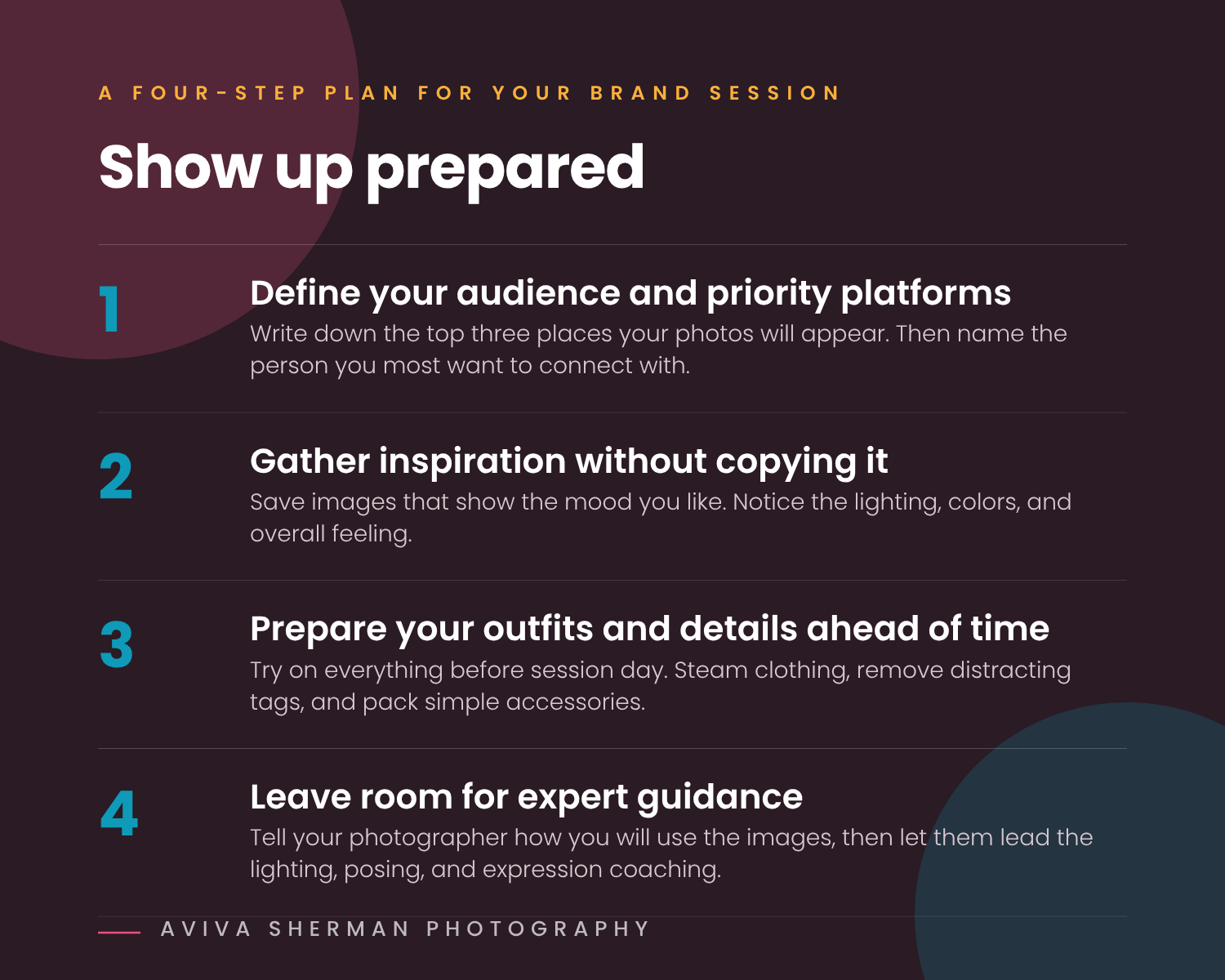
1. Define your audience and priority platforms
Write down the top three places your photos will appear. Then name the person you most want to connect with. This gives your session a practical direction from the start.
2. Gather inspiration without copying it
Save images that show the mood you like: warm and conversational, polished and editorial, creative and energetic, or calm and executive. Notice the lighting, colors, and overall feeling. Your final photos should be tailored to you, not a duplicate of someone else’s brand.
3. Prepare your outfits and details ahead of time
Try on everything before session day, including shoes if they may appear in the frame. Steam clothing, remove distracting tags, and pack simple accessories. Bringing a lint roller, glasses-cleaning cloth, and touch-up items can save small frustrations later.
4. Leave room for expert guidance
Preparation is useful. Over-directing yourself is not. Tell your photographer how you will use the images, what makes you feel self-conscious, and what you love about your appearance. Then let them lead the lighting, posing, and expression coaching. That is how you get photos that feel polished without becoming stiff.
Keep Your Final Images Working After the Session
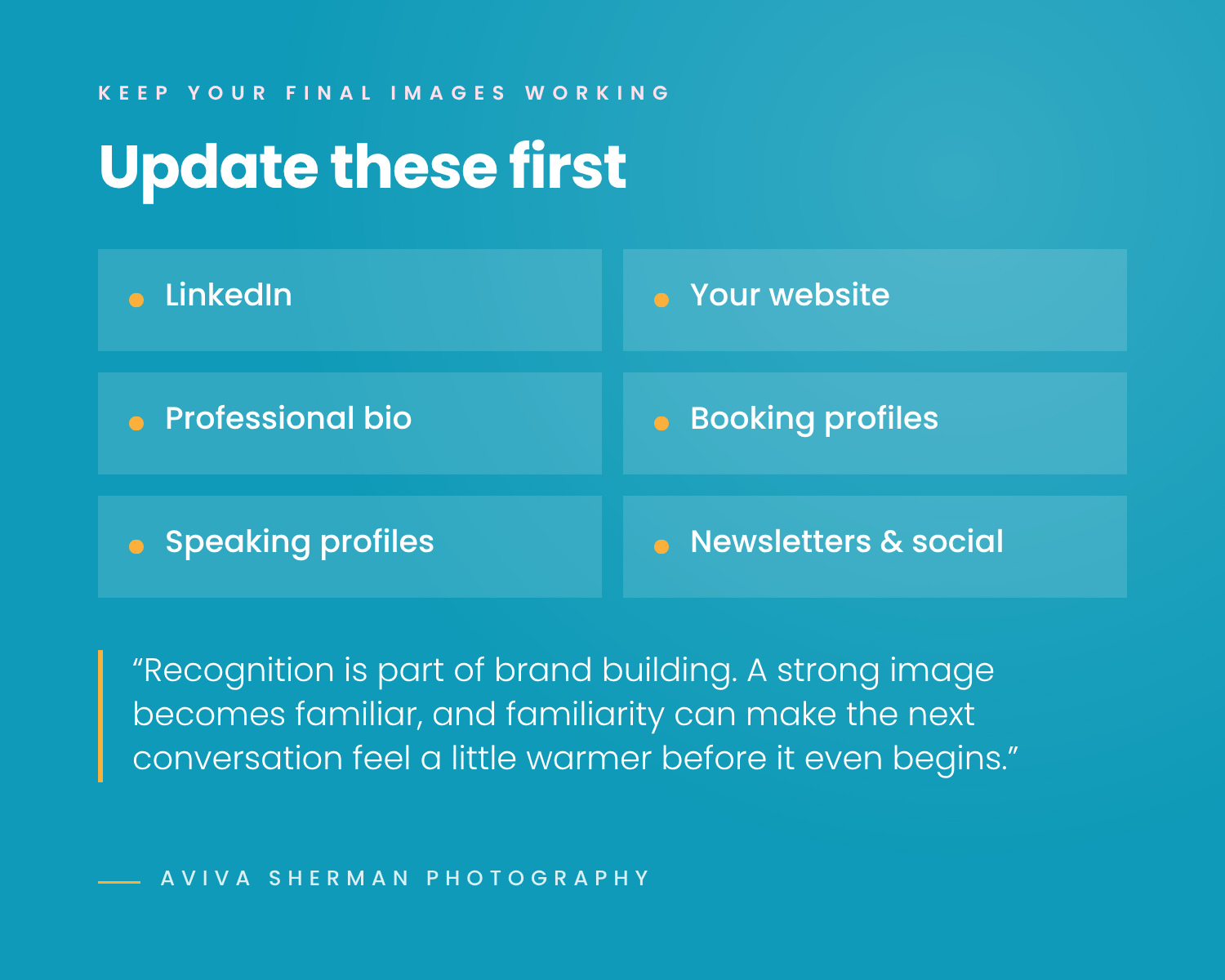
Once you have selected your favorites, update the places that matter most before your enthusiasm fades. Start with LinkedIn, your website, professional bio, and any booking or speaking profiles. Use the same primary portrait across major platforms when consistency matters, then rotate supporting images into social posts, newsletters, launch materials, and presentation slides.
Avoid changing your profile photo every few weeks simply because you have options. Recognition is part of brand building. A strong image becomes familiar, and familiarity can make the next conversation feel a little warmer before it even begins.
It is also worth scheduling a refresh before your current photo becomes noticeably outdated. For many entrepreneurs, that is every year or two. A new role, a major shift in your business, a changed look, or a growing public presence can all be good reasons to create new images. You are allowed to be seen as the person you are now.
Your brand photos do not have to make you look like someone else to create opportunity. They should help the right people see your experience, warmth, and confidence more clearly. Show up as yourself, give yourself good guidance, and choose the image that makes you think, “Yes, that is me on a really good day.”