Speaker Headshots That Get You Booked on More Stages
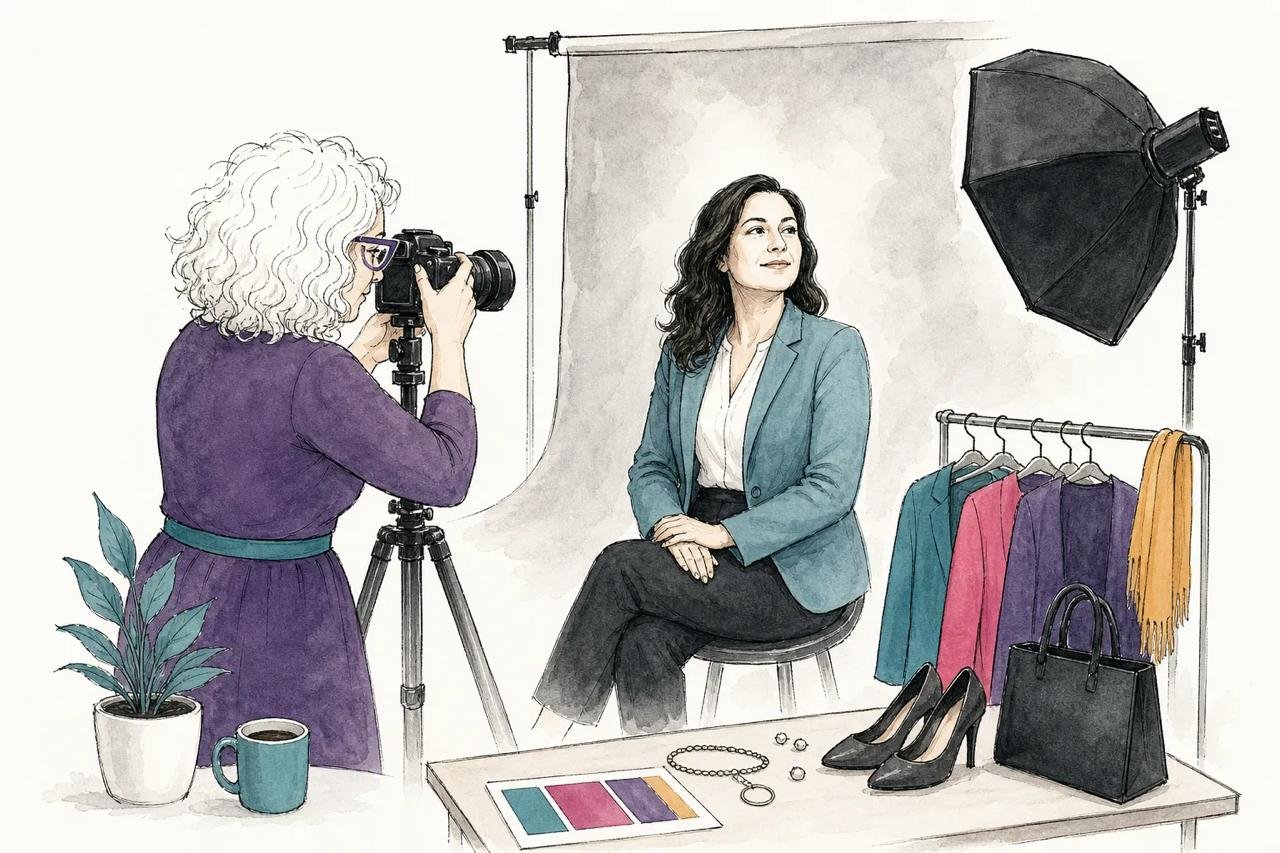
Table of Contents
- What event organizers notice before they read your bio
- Pose and expression for speaker headshots that project confidence
- Matching your expression to your brand positioning
- Framing and lighting for speaker headshots built for every format
- Crop options that cover every use case
- Lighting that matches your positioning
- Wardrobe that holds up in print, on screen, and in a program thumbnail
- Technical specs every speaker headshot submission should include
- Professional photography vs. AI headshots: what actually gets you booked
- Your headshot is working for you around the clock
When event organizers work through a stack of speaker submissions, your speaker headshots often register before anything else on the page. Photos are an early visual cue that shapes first impressions, and when a program committee is processing 50 to 100-plus proposals in a single sitting, a strong image can influence how everything that follows gets read. Your bio, your speaking topics, and your credentials all benefit from a photo that signals you belong on that stage. A weak one works against you before a word of your pitch lands.
A strong speaker portrait communicates two things at once: authority and approachability. That combination is harder to produce than it sounds, and many speakers, no matter how commanding they are in front of a live audience, report having little to no coaching for posed portrait work. The gap between a good speaker and a great speaker photo is almost always direction, not talent. It's why photographers who specialize in this work, like Aviva Sherman, guide clients through every expression and angle in real time rather than leaving them to figure it out on their own.
What follows is a practical breakdown of what event organizers actually respond to, and how to build stage-ready headshots that work across proposals, speaker bio pages, conference programs, and promotional materials.
What event organizers notice before they read your bio
Program committees and event coordinators review proposals at scale. A blurry photo, an outdated image that looks like it was taken five years and a hairstyle ago, or a stiff corporate portrait shot in a conference room can trigger doubt early, and that doubt tends to color how the rest of your submission gets read. Research on rapid facial judgments shows that viewers form trustworthiness and competence impressions within roughly 100 milliseconds, which means a poorly chosen image starts working against you faster than any written pitch can recover.
The visual question your speaker headshot answers is simple: does this person look like someone our audience would trust and want to hear from? That's not about attractiveness or age. It's about the specific combination of posture, expression, and framing that communicates both expertise and warmth. A speaker who projects only authority can feel intimidating and hard to approach. A speaker who projects only friendliness can read as a peer rather than an expert. The best public speaker headshots land squarely in the middle, and that balance is something a well-directed session produces on purpose, not by accident.
Pose and expression for speaker headshots that project confidence
The standard starting point for speaker portraits is a 30, 45 degree body turn rather than a dead-on, squared-up stance. Facing a camera straight-on reads as rigid and confrontational. The angled position creates natural shape, makes the shoulders look less stiff, and gives the image a sense of movement and engagement. From there, the chin goes slightly forward and down, which sharpens the jawline and prevents the "looking down your nose" effect that makes even warm people appear dismissive.
A slight forward lean from the waist, just a few degrees, adds engagement without aggression. It signals interest and presence. These adjustments are subtle in person but produce dramatically different results on camera, which is exactly why speakers who aren't used to modeling often freeze in a default stiff pose unless someone actively walks them through each adjustment. Without that direction, most people do what feels natural, and what feels natural rarely photographs the way it looks in your head.
Matching your expression to your brand positioning
Expression choices should match your brand positioning, not just whatever happens on your face when the camera clicks. Viewers form trustworthiness and competence impressions within roughly 100 milliseconds, a finding supported by decades of social psychology research, including a widely cited Princeton study, which means your expression in a still photo carries real strategic weight. There are three main expressions that work across speaker contexts:
- Approachable smile: Best for coaching, training, and community-oriented events where warmth is the primary signal.
- Quiet authority: A composed, direct expression that works for keynote speakers, executives, and leadership-focused positioning.
- Animated warmth: A secondary shot with genuine energy, useful for startup, innovation, or high-engagement event contexts.
Choosing the right expression for your specific speaking context is a strategic decision, not an aesthetic one.
Framing and lighting for speaker headshots built for every format
Speaker branding photos get used in more contexts than most photographers plan for during a shoot. Conference profiles, event app listings, printed programs, speaker one-sheets, social media graphics, and slide deck bios all have different crop requirements. A single well-framed session can cover all of them if the photographer builds in the right compositions from the start.
Crop options that cover every use case
Three practical crops cover most situations: head-and-shoulders for conference profiles and directories, three-quarter length for versatility when designers need space for title and logo overlays, and waist-up with deliberate hand placement for a fuller, more authoritative look. Negative space in the frame matters. Extra breathing room around the subject gives designers flexibility for text overlays on event banners and promotional graphics without having to awkwardly crop into your face.
Background choice is straightforward. Simple seamless backgrounds in light gray, charcoal, or warm neutrals keep the face as the visual anchor and leave room for text overlays in event programs. The goal is contrast: your face and expression need to read clearly at thumbnail size, because conference program grids and event app profiles display at very small sizes. Busy or cluttered backgrounds, even attractive ones, compete with your face at those scales.
Lighting that matches your positioning
Lighting which creates directional shadow and depth suits executive and keynote speakers who want gravitas and an editorial feel. Soft directional light works better for coaches, trainers, and community-focused speakers who want a warmer, more approachable result. Neither is universally correct; the lighting should match the positioning you want to establish, not just what the studio defaults to.
Wardrobe that holds up in print, on screen, and in a program thumbnail
The foundational rule for speaker wardrobe is a dark neutral base: navy, charcoal, black, and deep gray hold authority on camera without requiring the viewer to work past a distracting outfit. Solid colors almost always outperform patterns because they keep attention on your expression, which is where the authority lives.
The common mistakes are patterns that read as noise in smaller formats, bright logos that pull the eye away from your face, and high-contrast florals or prints that compete with your features when the image is reduced to a thumbnail. These issues are easy to miss when you're looking at a full-size image on your screen but become obvious the moment a conference coordinator drops your photo into a program layout.
Industry context shapes how you build from that neutral base:
- Corporate, finance, and legal: Dark suit, conservative shirt, minimal accessories, structured watch or simple jewelry.
- Tech, consulting, and startup: Charcoal or navy with a slightly softer top and one subtle accent piece that shows personality without losing authority.
- Creative and brand leadership: Same dark foundation, one controlled identity color or refined accessory that signals individuality.
- Academic, nonprofit, and public speaking: Neutral base with approachable accents in burgundy, steel blue, or forest green for contrast and warmth.
Accessories should sharpen the look, not compete with it, a simple watch, small studs, or a single refined accent item is enough. The goal is to look intentional, not decorated.
Technical specs every speaker headshot submission should include
Many speaker submission guidelines specify image requirements, so check each event's rules directly and deliver exactly what's requested; that attention to detail signals professionalism to coordinators managing dozens of speaker assets at once. As a baseline, the safest universal delivery set is one square JPEG at 2000×2000 pixels or larger, one portrait crop for printed programs and event apps, and one wider landscape crop for slide decks and banner-format promotions.
JPEG is the safest general-purpose format for speaker submissions. PNG is worth including for design teams that need lossless quality or transparency. For web and social-facing uses, sRGB is the correct color space. For print, the standard is 300 DPI at the final print size, so a headshot appearing in a conference program at 3 inches wide needs to be at least 900 pixels across at that resolution.
Going bigger than the minimum gives event coordinators flexibility. Going smaller forces them to crop or upscale, which creates friction and can produce visibly degraded results in print. A labeled image set, with files named clearly by crop type and size, removes guesswork for the coordinator and signals that you're a professional who's worked in this context before. That small detail reflects on your overall brand.
Professional photography vs. AI headshots: what actually gets you booked
AI-generated headshots run roughly $9 to $79 for a batch and deliver in hours. Professional studio sessions start around $150 to $600 with a standard 3, 7 business day turnaround, and some studios offer same-day delivery. For speaker bio pages and basic profile listings where speed and budget matter, AI can be sufficient. For keynote promotion, press kits, sponsorship decks, and high-visibility event marketing, the gap in authenticity and brand control is real.
AI outputs are often convincing at normal viewing distances, but they're digitally fabricated rather than camera-captured. Experienced event coordinators and designers can often detect AI-generated conference headshots, even when they can't articulate exactly why. Licensing is also a variable: AI image rights differ by platform and require verification, while a professional session delivers clear, contract-based usage terms that hold up in commercial contexts without ambiguity.
The more significant advantage of a professional session, though, is direction. Most speakers are highly skilled communicators in front of a live audience, but they've rarely been coached on what to do with their face and body when the room goes quiet and a lens is pointed at them. A directed session, where the photographer coaches every angle, expression, and pose in real time, consistently produces keynote headshots that look natural and confident rather than stiff and posed.
Aviva Sherman Photography is built specifically for this. Every speaker portrait session includes real-time coaching through every shot and same-day image review so you leave knowing you have what you need. For speakers who need their portrait to open doors, that level of direction isn't a nice-to-have. It's the entire point.
Your headshot is working for you around the clock
Your speaker headshots appear in proposal inboxes, on event websites, in conference programs, across social media announcements, and in sponsor materials long before you step on stage. Every one of those appearances is either building your credibility or quietly undermining it. Great speaker bio photos are planned, directed, and technically delivered for the formats that actually matter, balancing authority with approachability, holding up at thumbnail size, and matching your specific brand positioning.
If your current headshot is more than two years old, or if you've never worked with a photographer who actively coached you through the session, consider whether your image is giving your best work the introduction it deserves. For speakers in the Chicago area, Aviva Sherman Photography offers portrait sessions built specifically for speakers who need to walk away with images that open doors: no guessing, no stiff default poses, and no leaving the session uncertain about whether you got the shot. Just images that work.